The Caribbean Crucible: U.S. Military Posturing, Narco-Terrorism Narratives, and the Specter of Intervention in Venezuela
Feature • Analysis • September 2025
Introduction: A Region on Edge
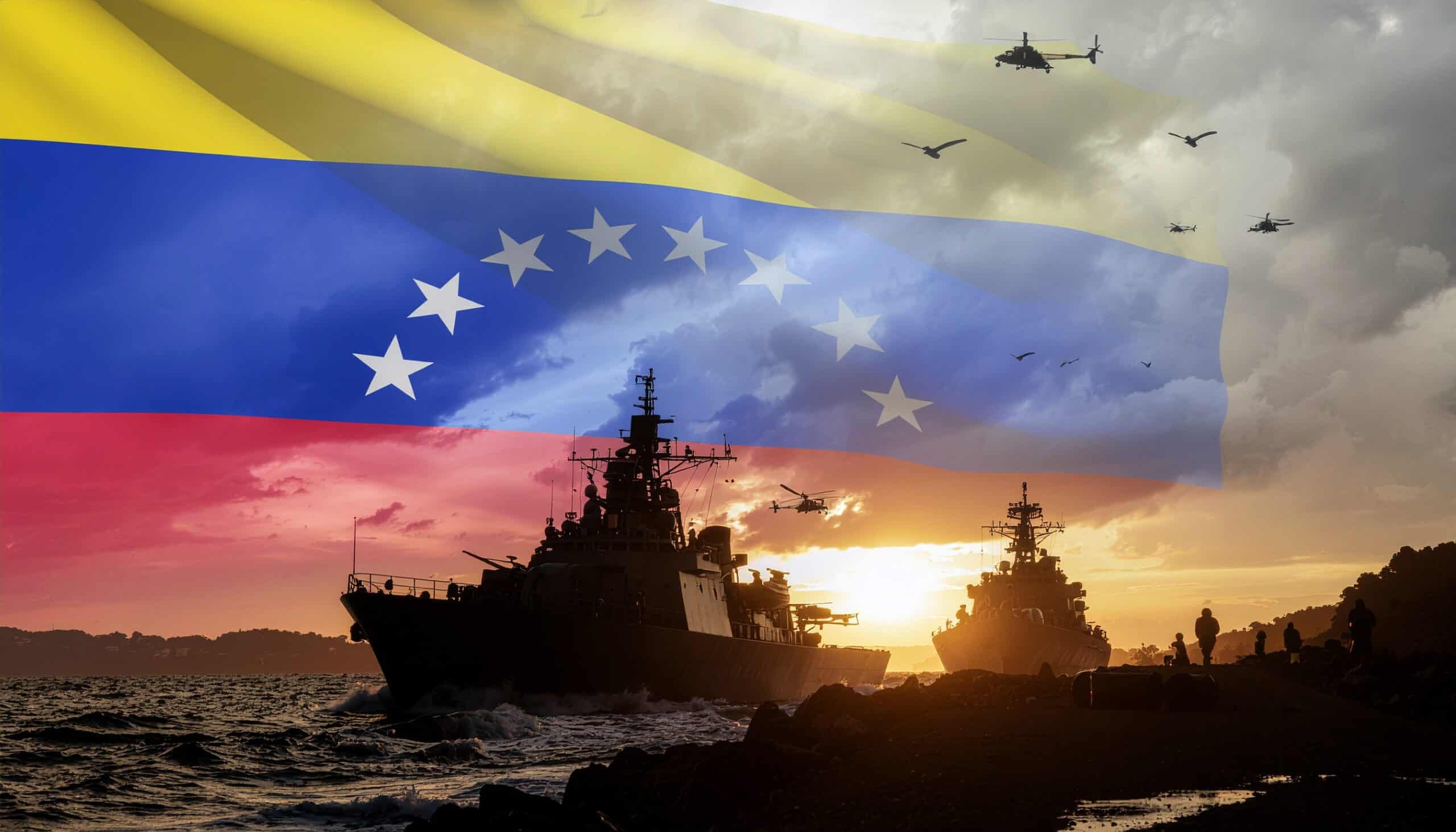
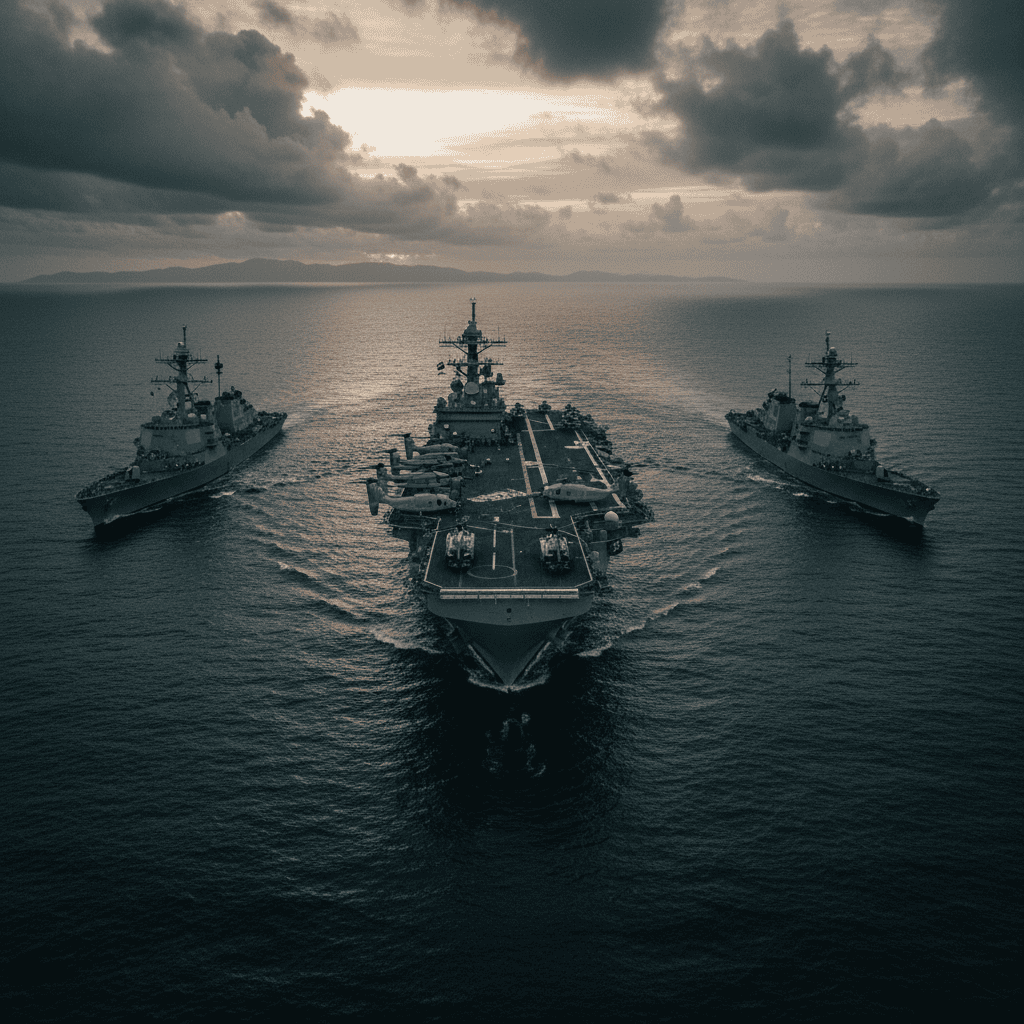
In the closing months of 2025, the Caribbean Sea has become the unlikely epicenter of a geopolitical storm. A formidable U.S. naval armada, backed by thousands of Marines, stealth aircraft, and submarines, now patrols waters just north of Venezuela. Officially, Washington insists this deployment is nothing more than an “enhanced counter-narcotics operation.” Yet the scale and character of the force—guided-missile destroyers, amphibious assault ships, and precision strike assets—tell a different story.
Is this really about drugs? Or is the United States edging closer to military intervention in Venezuela, home to the world’s largest oil reserves and a government Washington has long sought to topple?
The answer lies somewhere between deterrence, political theater, and the dangerous unpredictability of great-power rivalry.
In related news, see our detailed analysis of The Russia–North Korea Strategic Partnership and the Future of Global Order .
I. Anatomy of a Buildup
A Disproportionate Show of Force
The U.S. Southern Command (SOUTHCOM) has assembled one of the largest concentrations of military power in the Caribbean in decades. At its heart is the Iwo Jima Amphibious Ready Group, carrying more than 2,000 Marines from the 22nd Marine Expeditionary Unit. Surrounding them: Arleigh Burke-class destroyers armed with Tomahawk cruise missiles, the USS Lake Erie cruiser, littoral combat ships for shallow-water operations, and even the nuclear-powered USS Newport News submarine lurking beneath the waves.
This is not the toolkit of drug enforcement. These are the instruments of war—capable of seizing beaches, striking deep into Venezuelan territory, and neutralizing air defenses.
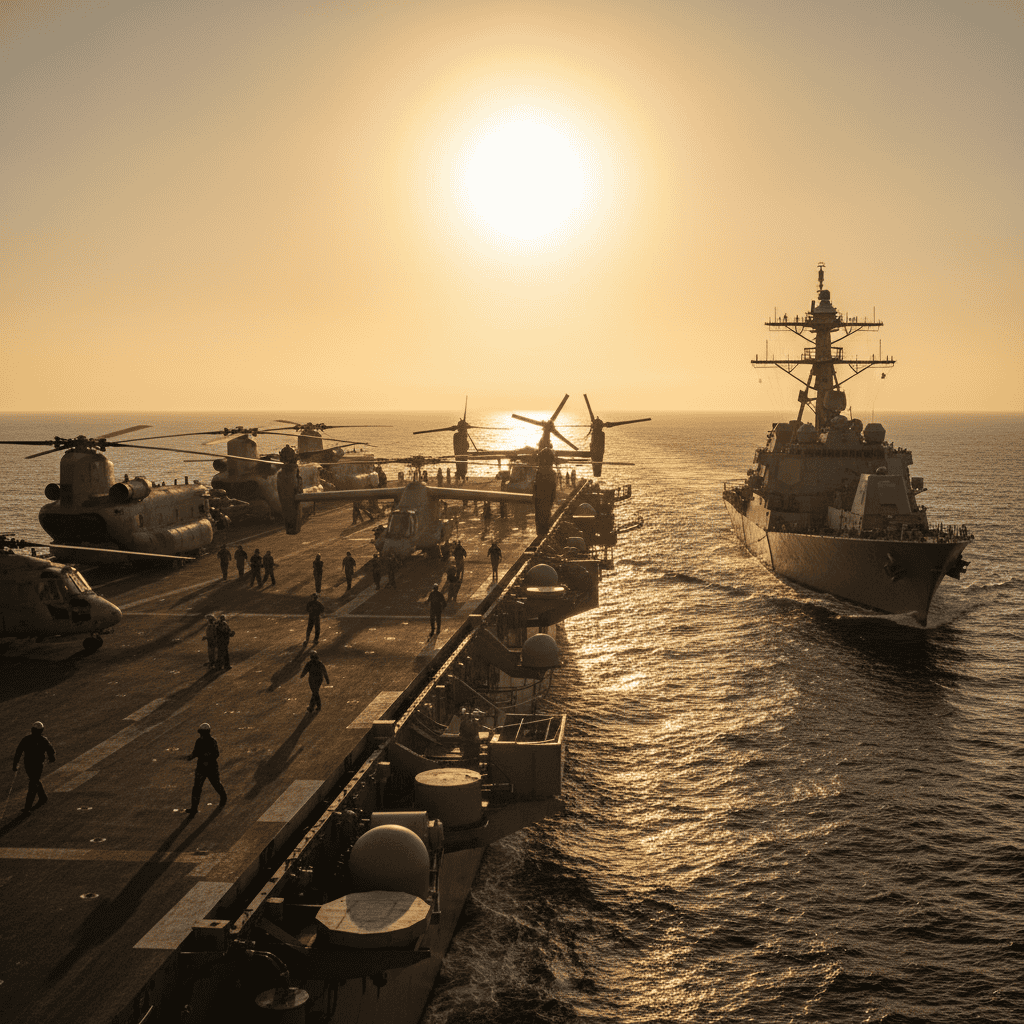
For decades, U.S. counter-drug missions followed predictable patterns: Coast Guard cutters hailed suspect vessels, fired warning shots, disabled engines, and arrested crews. But in September 2025, that script was abandoned. U.S. aircraft carried out “precision strikes” on boats allegedly tied to Venezuelan groups like Tren de Aragua, killing more than a dozen people. President Donald Trump celebrated the footage on social media, branding the operation a victory against “narco-terrorists.”
To critics, it was something darker: summary execution on the high seas, bypassing due process and shredding long-standing maritime norms.
The OSINT Spotlight
If secrecy once shielded such maneuvers, the rise of open-source intelligence (OSINT) has stripped it away. Civilian analysts, armed with commercial satellite images, tracked the U.S. armada in real time. Social media feeds lit up with grainy but verifiable images of warships edging closer to Venezuela. Far from undermining Washington, this visibility amplified the message: the U.S. wants Caracas—and the world—to see its power.
II. Washington’s Justification
Fusing Drugs and Terror
The Trump administration reframed Venezuela not simply as a corrupt, authoritarian regime but as a narco-terrorist state. By designating groups like Cartel de los Soles and Tren de Aragua as Foreign Terrorist Organizations (FTOs), Washington blurred the line between crime and terrorism. Suddenly, drug traffickers became “terrorists,” giving the White House a legal and political pretext for deploying the military.
“Maduro is the head of a drug-trafficking logistics organization,” declared Secretary of State Marco Rubio, echoing Trump’s rhetoric.
The Legal Labyrinth
The strikes rest on a controversial interpretation of Article II powers—the idea that the President, as Commander-in-Chief, can use military force in self-defense without Congress. By labeling Venezuelan cartels an “immediate threat,” the White House bypassed both U.S. law-enforcement procedures and international maritime law.
Legal scholars warn this precedent is perilous. If the U.S. can summarily strike “criminals” abroad, what stops Russia or China from targeting groups they define as threats?
Domestic Politics at Play
Policy insiders point to figures like Stephen Miller, Trump’s hardline deputy chief of staff, as key architects. By linking Venezuelan “narco-terrorists” to immigration and border security, the administration found a way to weave foreign policy into domestic politics—energizing its base while sidestepping diplomatic compromises.
Sanctions as the Prelude
The military buildup complements years of economic warfare. From indicting Maduro on narco-terrorism charges to banning Venezuelan oil exports and imposing punitive tariffs on countries that trade with Caracas, sanctions have systematically strangled Venezuela’s economy. But their failure to force regime change fueled the turn to more coercive, militarized tactics.
III. Caracas Responds
Defiance and Mobilization
President Nicolás Maduro has cast the U.S. deployment as the gravest threat in a century, vowing to transform Venezuela into a “republic in arms.” State television broadcasts militia drills, with civilians clutching rifles and pledging to resist an invasion. The message is clear: any U.S. intervention will be met with nationwide insurgency.
Military Deterrence
Venezuela’s regular forces, backed by Russian-made Su-30 fighter jets and S-300 air defense systems, have staged high-profile exercises. Fighter jets buzz U.S. ships in risky fly-bys. Coastal defenses are reinforced. The Bolivarian Militia—millions strong on paper, if not in combat effectiveness—has been mobilized as a symbol of resistance.
Caracas knows it cannot match U.S. firepower. Its strategy is deterrence through costs: making any invasion long, bloody, and politically unsustainable.
IV. A Divided International Arena
Latin America’s Fractures
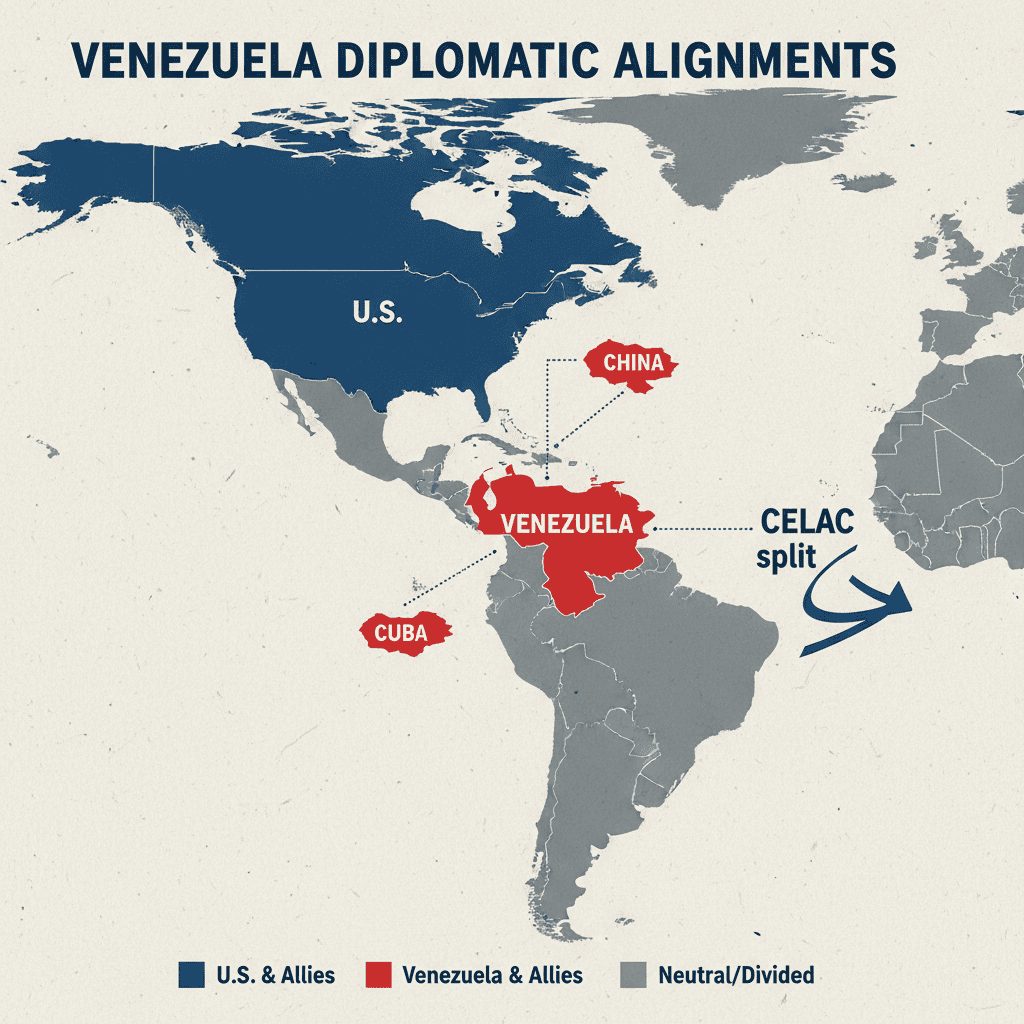
The crisis has exposed rifts in regional diplomacy. In September 2025, CELAC condemned the U.S. presence as a threat to regional peace—but nine countries, including Argentina and Peru, refused to sign. The OAS, often aligned with Washington, remains hamstrung by divisions and weak enforcement powers.
The result: paralysis. Latin America cannot agree on whether the U.S. is a protector or a predator.
Russia and China Step In
Moscow condemned the deployment as naked imperialism and reaffirmed its strategic partnership with Caracas. Russian arms sales and military advisors bolster Venezuela’s defenses, while Russian media amplifies the narrative of U.S. aggression.
China, with billions invested in Venezuelan oil, issued stern warnings against “the threat of force.” While less confrontational than Russia, Beijing’s economic lifeline keeps Maduro afloat. Together, their support turns a bilateral U.S.–Venezuela standoff into a new front in global great-power competition.
V. Scenarios and Consequences
Why Venezuela Is Not Panama
Some in Washington invoke the swift 1989 U.S. invasion of Panama as precedent. But the comparison is misleading. Venezuela is vastly larger, with a 350,000-strong military, rugged terrain, and tens of thousands of armed civilian colectivos. Analysts estimate that a full-scale invasion could require 100,000–150,000 U.S. troops—a far cry from Panama’s 4,000 defenders.
Unlike 1989, the U.S. would also face direct opposition from Russia and China, raising the stakes far beyond regime change.
Oil Shockwaves
Though Venezuela’s output has collapsed to about 1 million barrels per day, its reserves remain the largest on Earth. A conflict would not only halt exports but also destabilize vital Caribbean shipping routes. Even the threat has already spooked markets. Energy analysts warn of a global oil price surge with ripple effects from New Delhi to Berlin.
A Humanitarian Disaster
Perhaps the gravest consequence would be human. Venezuela is already enduring one of the world’s worst refugee crises: 7.7 million people have fled since 2014. A conflict could unleash a further 10 million refugees, overwhelming Colombia, Brazil, and the region. Aid pipelines would collapse, leaving millions trapped in dire conditions.
This is the nightmare scenario: a failed state on the Caribbean’s doorstep, hemorrhaging people and destabilizing the hemisphere.
Optional: Key Events Timeline
(If your WordPress blocks scripts, skip this chart or embed via a trusted plugin.)
VI. Between Pressure and War
The U.S. strategy is both bold and brittle. By deploying overwhelming force under the guise of “counter-narcotics,” Washington signals resolve while stopping short of invasion. But the danger lies in the gray zone. With warships shadowing one another, drones circling overhead, and political leaders locked into hardline narratives, the chance of miscalculation is alarmingly high.
A Venezuelan fighter jet strays too close. A U.S. missile misfires. A limited strike escalates. Suddenly, the Caribbean becomes the site of a war no one planned but everyone feared.
Conclusion: The Crucible’s Lesson
The U.S.–Venezuela standoff of 2025 is more than a regional dispute. It is a crucible testing three things at once:
- The limits of U.S. coercive power in its own hemisphere.
- The resilience of international law in an era of blurred lines between crime and war.
- The fragility of Latin America’s stability, caught between authoritarianism at home and militarized intervention from abroad.
For now, the crisis simmers at the edge of catastrophe. The U.S. flexes its muscles, Venezuela raises its fists, and the world watches anxiously. Whether this ends in diplomacy or disaster depends less on firepower and more on restraint.
Because in the Caribbean crucible of 2025, the most likely war is not the one anyone wants—but the one no one prevents.
Similar Posts
An Axis of Convenience and Conviction: The Russia–North Korea Strategic Partnership and the Future of Global Order
An Axis of Convenience – The Truth Beyond The Fog NebulaReports Feature • Analysis • September 2025
An Anthem of Allegiance: Alberta’s Vigils for Charlie Kirk and the Forging of a Transnational Conservative Identity
An Anthem of Allegiance – NebulaReports The Truth Beyond The Fog Feature • Analysis • September 2025
America First, Israel Exception: Aid, Strategy, and Hypocrisy in the Trump Era
America First, Israel Exception – The Truth Beyond The Fog NebulaReports Feature • Analysis • September 2025
The Riyadh–Islamabad Axis: Anatomy and Implications of the 2025 Strategic Mutual Defense Agreement
The Riyadh–Islamabad Axis – The Truth Beyond The Fog NebulaReports Feature • Analysis • September 2025