
The Vanished Imam and the Digital Ghost: How Forensics Reopened a 50-Year Mystery
Feature • Investigative Analysis • September 2025
Introduction
For nearly half a century, the disappearance of Imam Musa al-Sadr has stood as one of the Middle East’s most enduring enigmas. A towering figure—physically and intellectually—al-Sadr was not merely a religious leader but a political visionary who reshaped Lebanon’s marginalized Shia community. When he vanished in Libya in August 1978, the event sent shockwaves far beyond Lebanon, reverberating across Iran, the Arab world, and even the Vatican.
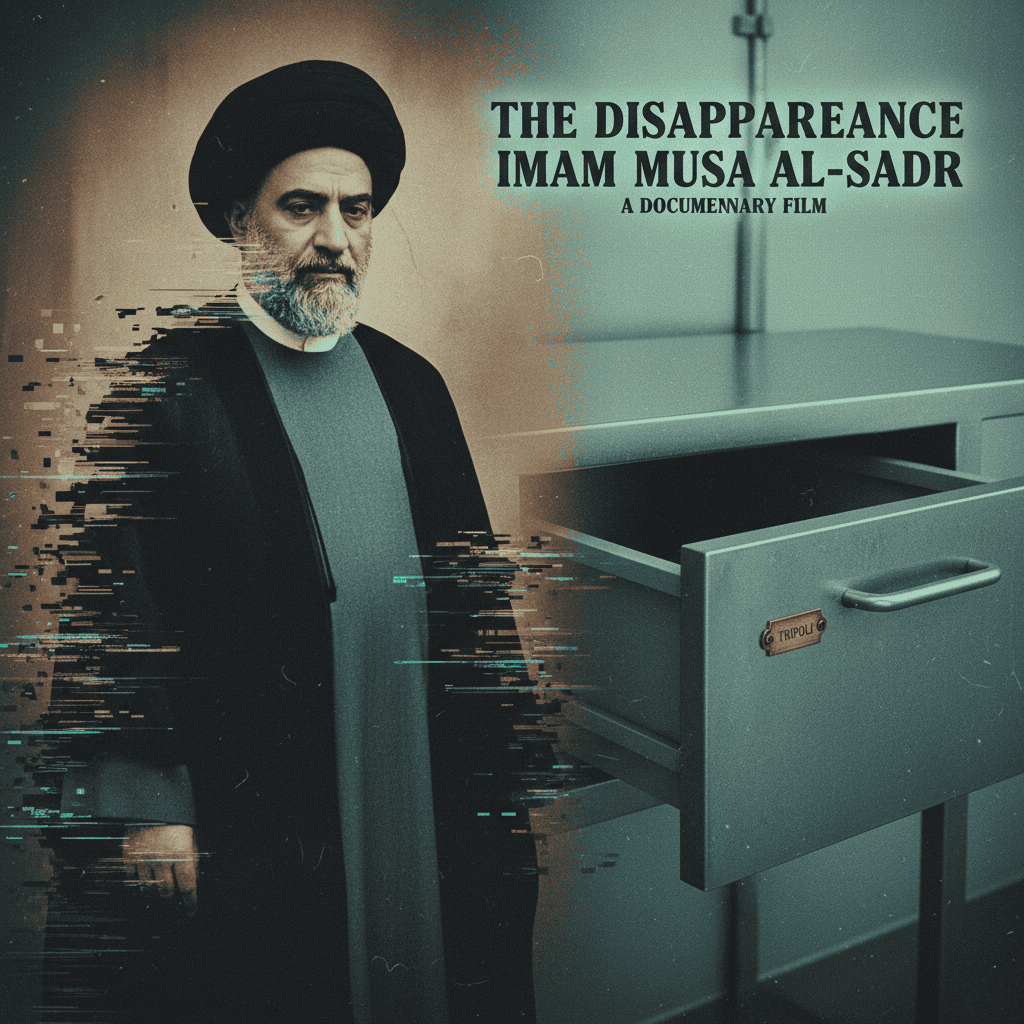
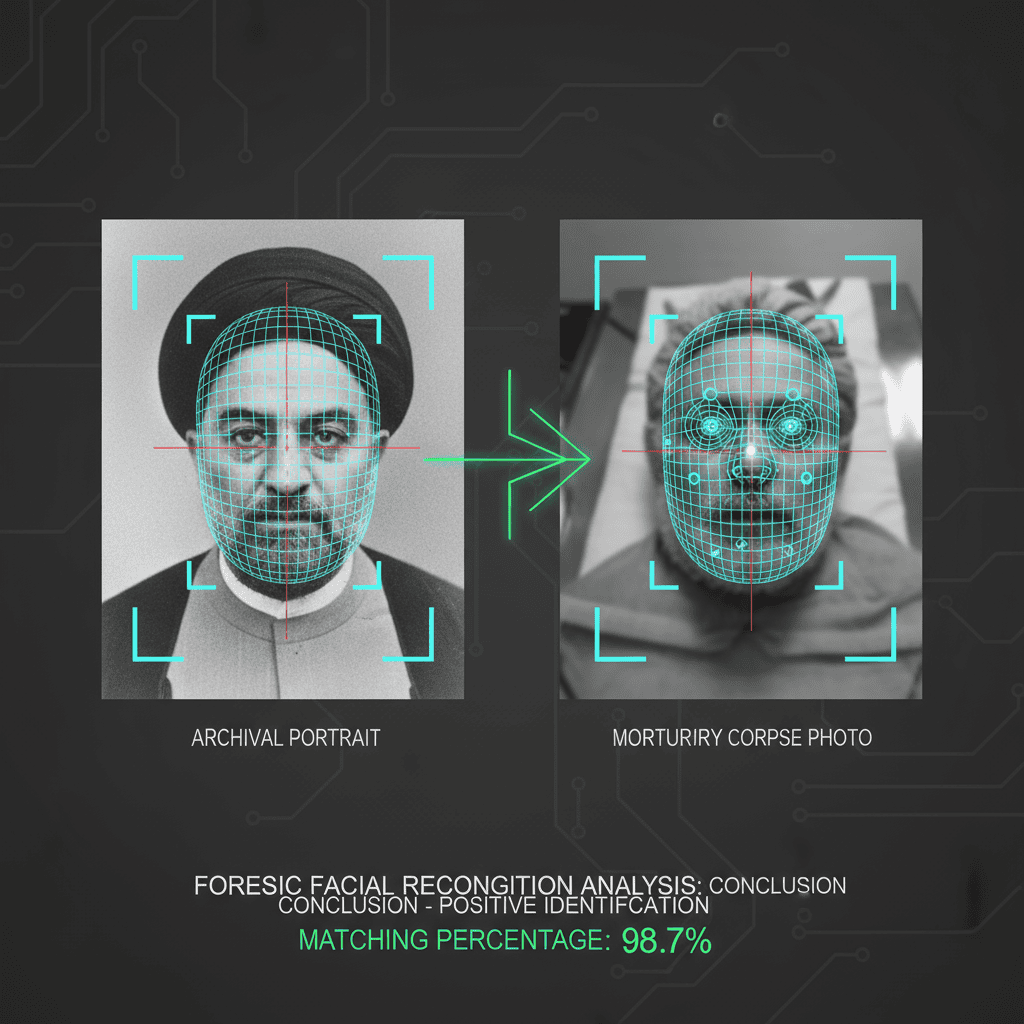
In 2025, the story took a startling turn. A BBC investigation harnessed cutting-edge facial recognition technology on a forgotten photograph of a corpse discovered in a Tripoli mortuary during the fall of Gaddafi’s regime in 2011. The analysis concluded there was a “high probability” the body was that of Musa al-Sadr.
If true, this revelation does more than close a cold case. It collides with decades of political myth-making, religious symbolism, and geopolitical cover-ups. It pits forensic probability against entrenched narratives—revealing that the obstacles to truth are not scientific, but political.
Part I: The Man Who Awakened a Nation
To understand why Musa al-Sadr’s disappearance mattered—and why his possible rediscovery still shakes the Middle East—we must first understand who he was.
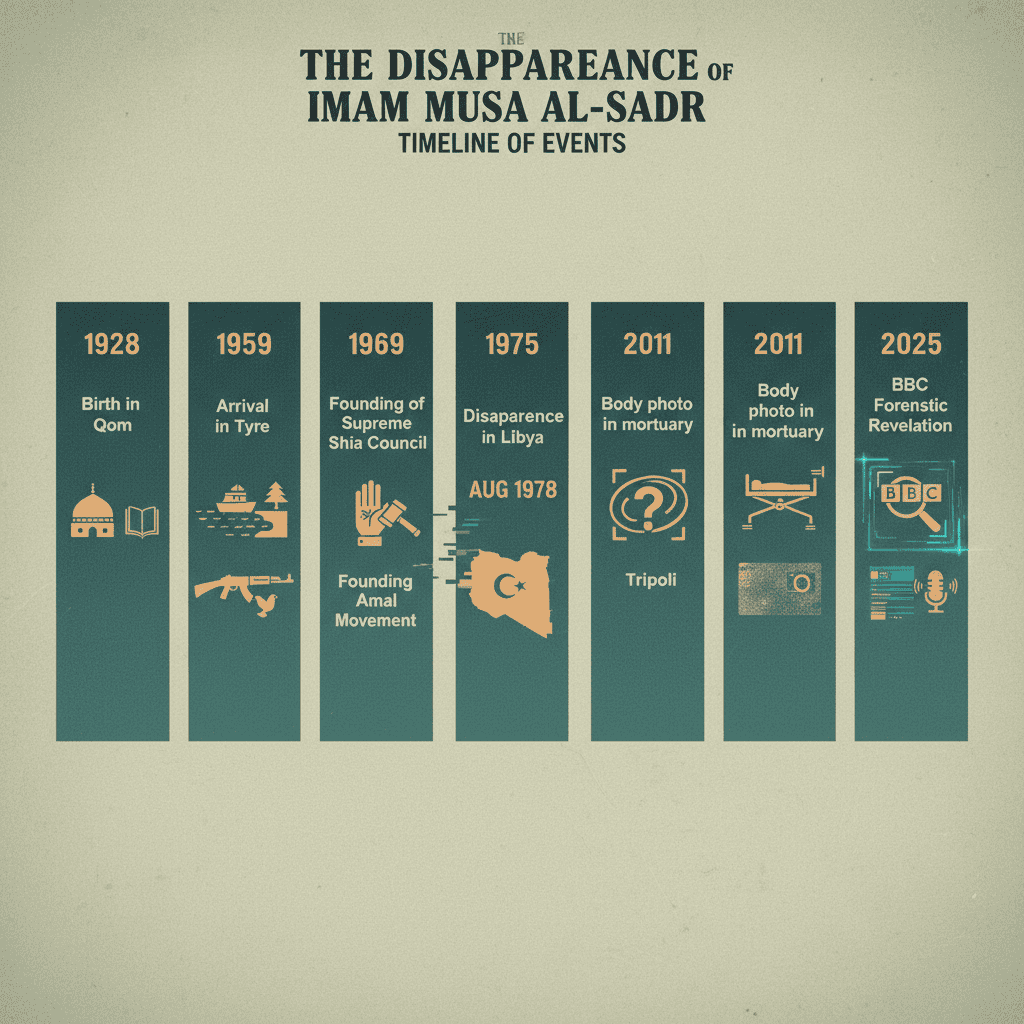
Born in 1928 in Qom, Iran, into a respected clerical family with Lebanese roots, al-Sadr embodied a unique dual identity. Educated in both theology and modern law, he arrived in southern Lebanon in 1959 to lead a disenfranchised Shia community long excluded from the state’s sectarian order.
He built schools, clinics, and institutions, culminating in the 1969 founding of the Supreme Islamic Shia Council—the first official body giving Lebanese Shia a unified political voice. By 1975, as civil war engulfed Lebanon, he established the Amal Movement (“Movement of the Deprived”), both a social platform and an armed defense force.
But al-Sadr was more than an organizer. At 6’5”, with magnetic charisma, he bridged divides at a time of deep sectarian fracture. He preached in Christian churches, courted dialogue with the Vatican, and championed an ecumenical, moderate vision of Shia Islam. This made him both a beloved leader and a threat—to Israel, to Palestinian factions, to Gaddafi, and perhaps most of all, to the hardline Iranian revolutionaries rising around Ayatollah Khomeini.
For many Shia, his vanishing carried religious echoes of the “Hidden Imam”—the messianic figure in Shi’ite theology who disappeared but is expected to return. Musa al-Sadr became the “Vanished Imam,” suspended between martyr and messiah.
Part II: A Fateful Journey into Silence
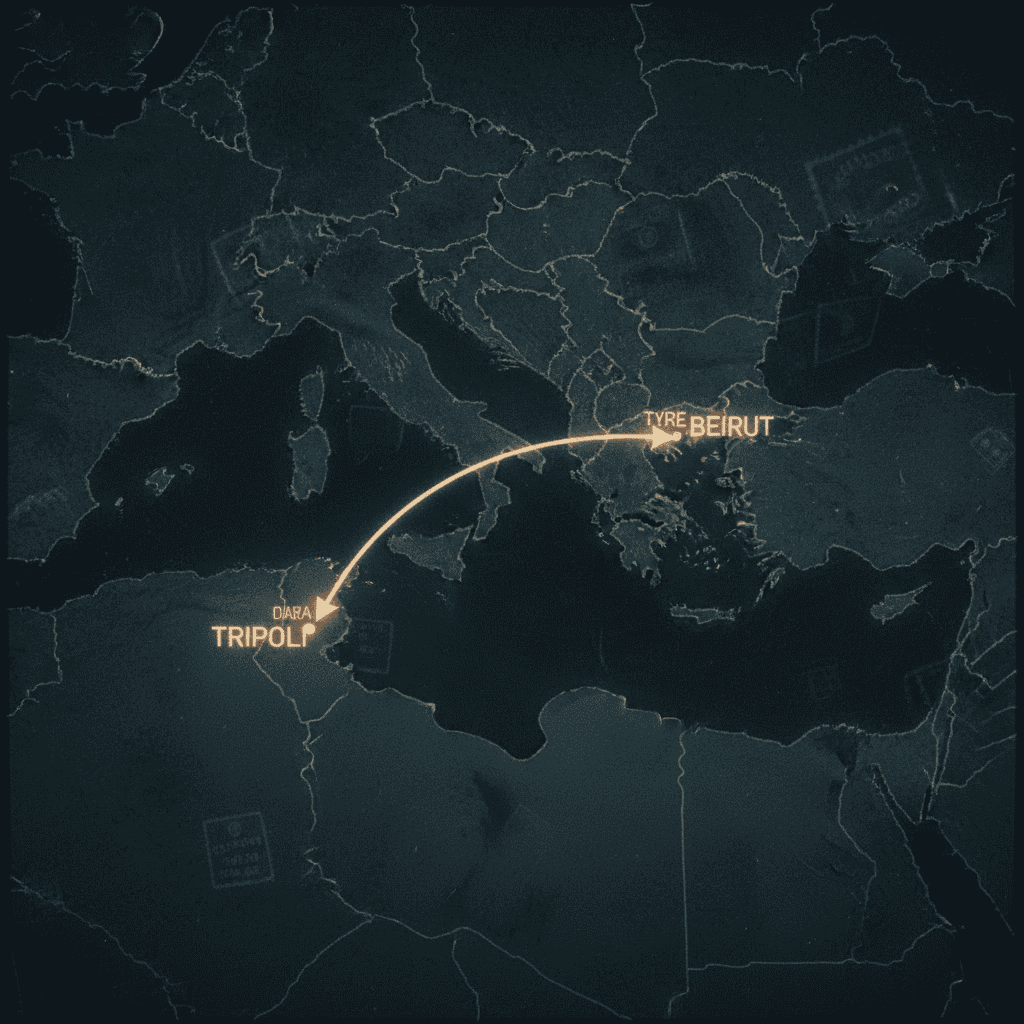
In August 1978, Musa al-Sadr embarked on a mission that would be his last. Accompanied by Sheikh Mohamad Yaacoub and journalist Abbas Bader el-Dine, he traveled to Libya at Muammar Gaddafi’s invitation.
The context was dire. After the expulsion of the PLO from Jordan in 1970, Palestinian guerrillas had entrenched themselves in southern Lebanon, using it as a base for cross-border raids into Israel. Israel’s retaliation—culminating in the March 1978 “Operation Litani” invasion—devastated Shia villages. Al-Sadr sought to persuade Gaddafi, the PLO’s key patron, to rein in the militants and spare southern Lebanon further catastrophe.
But al-Sadr and his companions never returned. Last seen on August 31, Libyan officials claimed they boarded a plane to Rome—a claim swiftly debunked by Italian authorities. The cover-up was crude but effective. From that day, Musa al-Sadr vanished.

Part III: Decades of Darkness – Theories and Myths
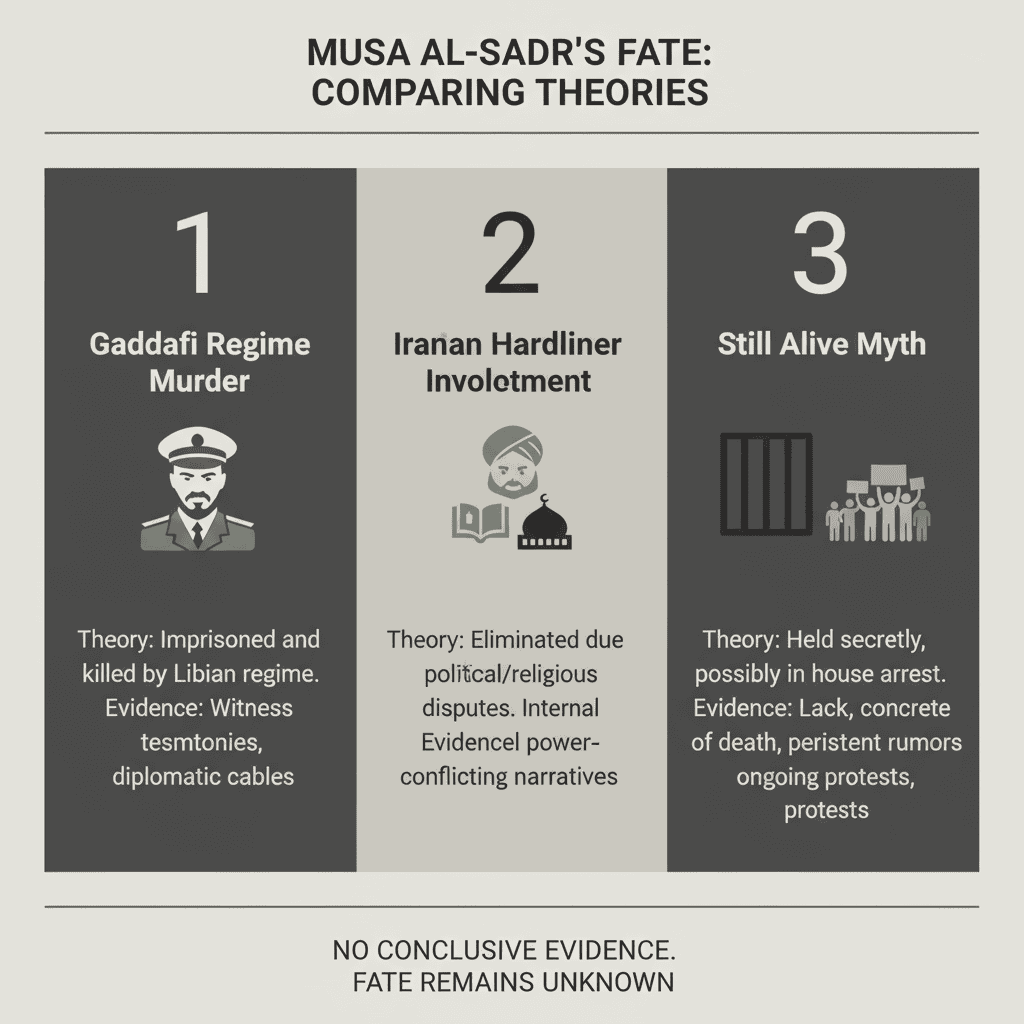
1) The Gaddafi Regime: The most widely accepted explanation is the simplest: Gaddafi had him killed. Former Libyan officials later admitted as much, and Lebanon formally indicted Gaddafi in 2008. His disappearance fit a pattern in a regime notorious for silencing opponents.
2) Iranian Hardliner Complicity: Another theory suggests Gaddafi acted at the urging of Iranian revolutionaries who saw al-Sadr as a rival. Al-Sadr’s moderate, outward-looking vision threatened Khomeini’s austere theocracy. Some accounts even claim senior revolutionaries urged Gaddafi to detain him.
3) The “Still Alive” Narrative: Yet within Lebanon, a different story took hold: that al-Sadr remained alive, imprisoned in Libya. For the Amal Movement, this narrative preserved unity, avoided succession struggles, and transformed al-Sadr into a perpetual living cause. His supposed captivity justified political leverage—including the detention of Hannibal Gaddafi in Lebanon since 2015. The myth became indispensable. To declare him dead risked collapsing a movement built on his symbolic presence.
Part IV: The Secret in the Mortuary
In 2011, as Gaddafi’s regime crumbled, journalist Kassem Hamadé stumbled upon a chilling discovery in a secret Tripoli mortuary: 17 bodies preserved in refrigerated drawers. One corpse stood out—exceptionally tall, resembling al-Sadr. Hamadé photographed the face and collected hair follicles.
The photograph sat in silence for years. The hair sample was handed to Amal officials—then mysteriously “lost.”




Similar Posts
The Epstein Enigma: A Comprehensive Analysis of Crime, Conspiracy, and Corruption
The Epstein Enigma – The Truth Beyond The Fog NebulaReports Feature • Investigation • September 2025
The Vanishing at the Divide: Unraveling the Mystery of Kris Kremers and Lisanne Froon
The Vanishing at the Divide: Unraveling the Mystery of Kris Kremers and Lisanne Froon – The truth Beyond The Fog…
A Partially Open Door: The 40-Year Hunt for a Killer in Robert Redford’s Shadow
A Partially Open Door – The Truth Beyond The Fog NebulaReports Feature • Investigations • September 2025