
From Miracle Material to Viable Solution: Graphene and the Future of Global Water Security
Science & Innovation • Feature • September 2025
Introduction
Water is life, yet billions still lack reliable access to it. As climate volatility, urbanization, and industrial growth strain supplies, engineers and policymakers are chasing solutions that can scale without wrecking ecosystems or national budgets. Among the most hyped candidates is graphene—a one-atom-thick carbon lattice whose extraordinary properties have captivated labs and headlines alike. Can it reset desalination’s energy math and ease the pressure of the global water crisis? Or will manufacturing realities and physics-imposed trade-offs keep it in the realm of promising prototypes?
This article takes a clear-eyed, evidence-driven look at graphene’s desalination potential alongside two other frontier approaches—atmospheric water harvesting and solar-thermal aerogels. The verdict: no single magic bullet exists, but the right portfolio, matched to context, can move us from scarcity toward resilience.
1) The Global Water Imperative: Context & Benchmarks
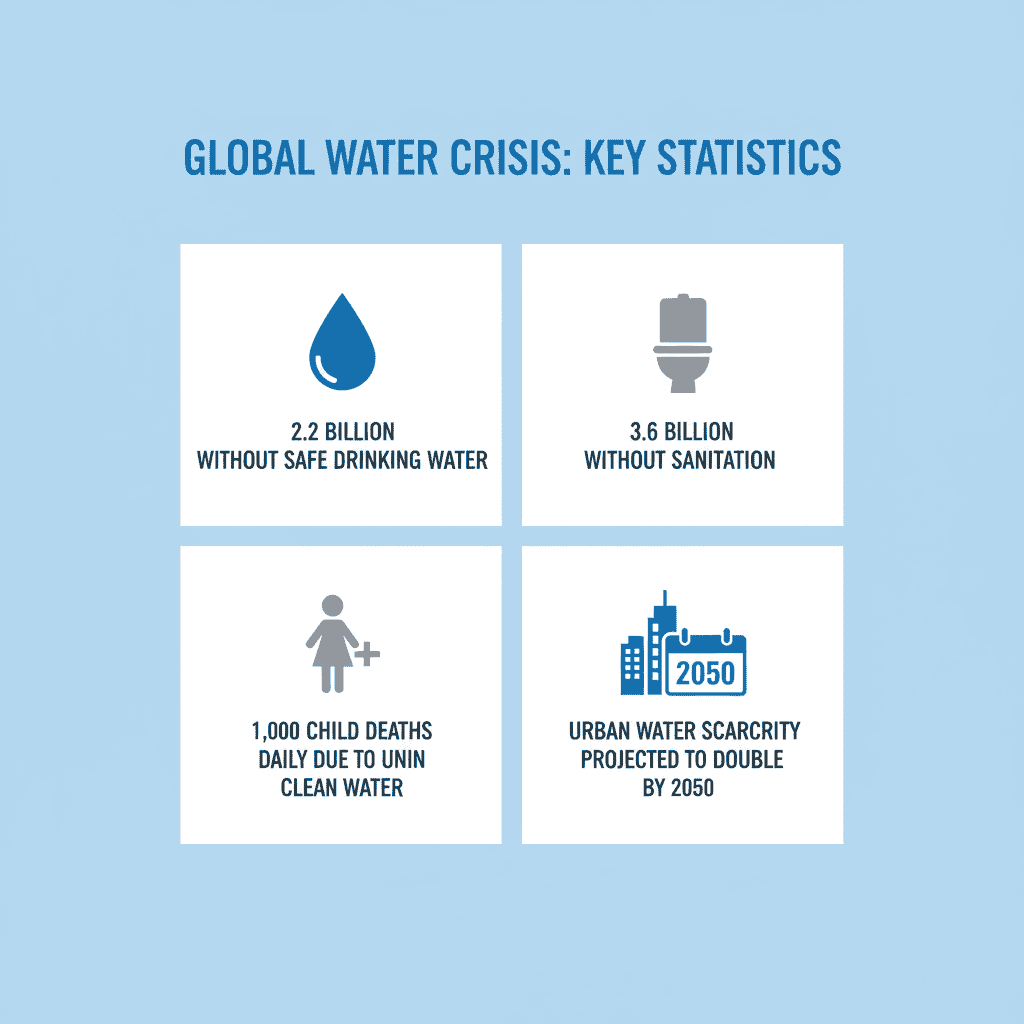
The crisis is both immediate and multifaceted. Recent assessments estimate that over two billion people lack safely managed drinking water. Hundreds of millions experience seasonal to chronic shortages, and climate change is amplifying the extremes—longer droughts, harsher floods, and disrupted hydrological patterns. Urban water stress is projected to more than double by mid-century, with consequences for food systems, energy, and public health.
Crucially, the problem splits into two intertwined dimensions: an access crisis (infrastructure, affordability, governance) and an availability crisis (not enough renewable freshwater to meet demand). Technologies that merely create “new water” aren’t enough; they must also be deployable where people live, at prices utilities and households can support, and with environmental footprints communities can accept.
1.2) The Incumbent: Reverse Osmosis (RO)
Reverse osmosis (RO) dominates modern desalination. It pushes seawater through polymer membranes at high pressure, capturing freshwater and rejecting salts. Today’s large SWRO plants often consume roughly 2.4–5.5 kWh per cubic meter—dramatically better than the 1990s, yet nudging closer to thermodynamic limits. Energy remains the largest operating cost; brine disposal burdens local ecosystems; and membranes foul over time, demanding chemicals, maintenance, and replacement.
After decades of optimization, RO’s gains are increasingly incremental. To break the energy–cost curve, the separation mechanism itself must change. That’s where atomically thin materials like graphene promise a step-change.
2) Graphene-Based Desalination: The Science Behind the Sieve
Pristine graphene is an impeccable barrier—even helium can’t cross. To filter water, researchers either perforate mono-layer graphene with sub-nanometer pores or, more tractably, stack sheets of graphene oxide (GO) into laminates where nano-capillaries form between layers. Water molecules (~0.26 nm) traverse these channels while larger, hydrated salt ions are ideally excluded. Reality complicates this picture: ions can partially dehydrate to squeeze through tight channels, undermining perfect salt rejection.
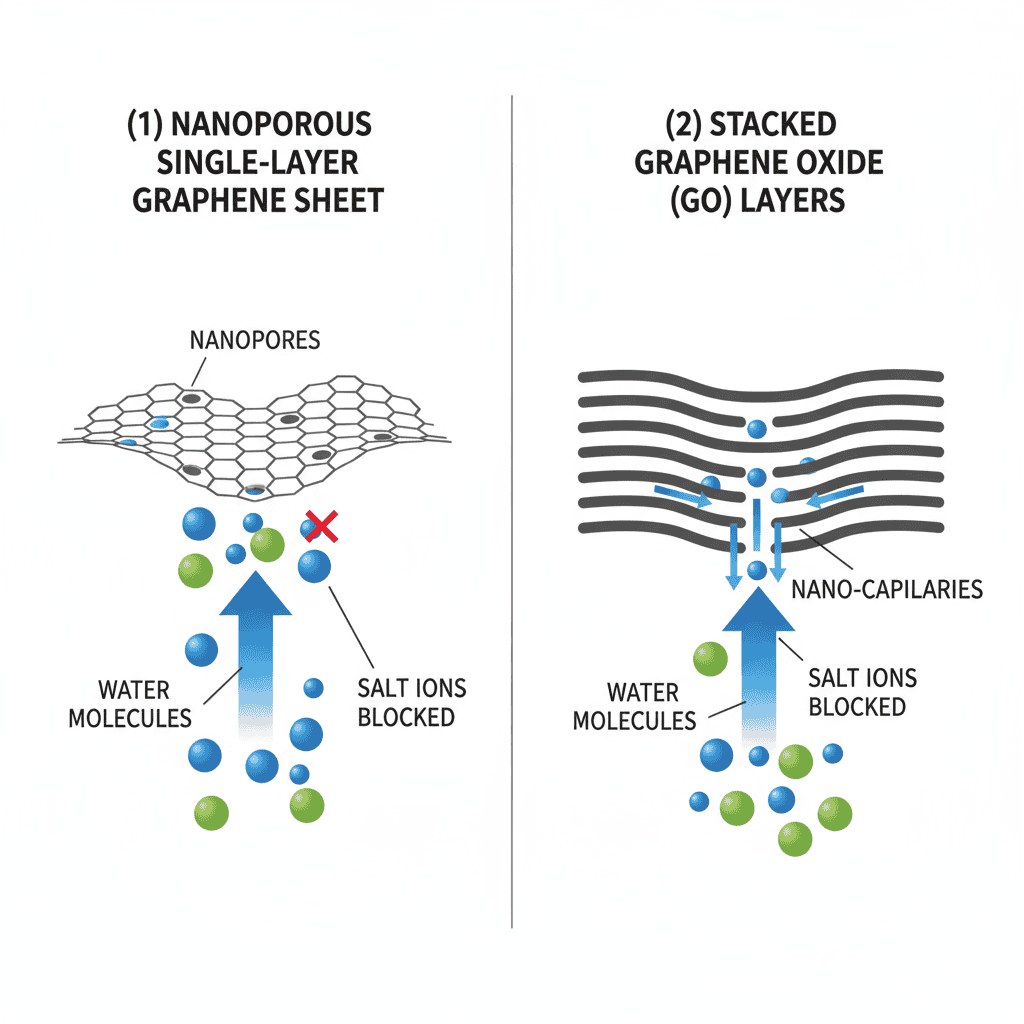
2.2) Performance Metrics & the Permeability–Selectivity Trade-off
Across experiments, GO membranes excel at rejecting larger, divalent ions (e.g., sulfate), with reported rates around 98–99%. Yet for seawater’s chief culprits—sodium and chloride—published rejection rates often range from ~30% to ~57%, well below the >99% single-pass standard needed for potable water. Meanwhile, measured water permeance can be impressive (tens to >80 LMH/bar in some setups), but tightening channels to boost salt rejection typically slashes flux. It’s the classic trade-off: fast or selective—rarely both.
Optional: Flux vs. Rejection (Illustrative)
Schematic data illustrating the typical permeability–selectivity tension in GO membranes.
2.3) The Path to Viability: Four Critical Hurdles
- Swelling & Stability: Hydrophilic GO layers take up water and swell, widening channels. Fixes include epoxy confinement, chemical cross-linking, and partial reduction to tighten spacing.
- Scalable Manufacturing: Lab-scale samples look great; square-meter, defect-controlled membranes are the real test. Uniform sub-nanometer pores and quality GO at ton scale remain challenging.
- Mechanical Robustness: High-pressure operation demands composite supports that preserve nano-channels over years, not weeks.
- Cost-Effectiveness: Falling GO prices help, but precision processing dominates cost. Any product must compete with mature, mass-produced RO polymers.
Given this, graphene’s most pragmatic near-term beachhead is nanofiltration and brackish water treatment, where lower salinity and pressure make even modest permeability gains valuable.
3) Beyond the Ocean: Decentralized Water Generation
3.1 Harvesting Water from Air
The sky holds ~13,000 km³ of fresh water at any given time. New sorbents make it harvestable:
- Biopolymer Hydrogels: Soil-mixed “sponges” that absorb nighttime humidity and release moisture to roots by day—useful for agriculture in drylands.
- Metal-Organic Frameworks (MOFs): Crystalline scaffolds with huge surface areas, tuned to adsorb water even at 10–20% RH. Field devices have demonstrated ~1.3–3.5 L/kg/day, with lab projections higher.

For coastal or brackish locales off the grid, 3D-printed aerogels infused with carbon nanotubes wick water and convert sunlight to localized heat, evaporating pure vapor while leaving salts behind. Yields are comparable to solar stills (on the order of a few liters per m² per day) but with designs that scale without losing efficiency.

| Technology | Source | Energy Input | Typical Output | Key Advantage | Primary Challenge |
|---|---|---|---|---|---|
| Graphene/GO Desalination | Seawater/Brackish | Electrical (pressure) | High flux; NaCl rejection variable | Potential lower energy vs RO | Scalable, defect-free manufacturing |
| Atmospheric Water Harvesting (MOFs) | Air humidity | Low-grade heat for release | ~1.3–3.5 L/kg/day (field) | Works inland, even at low RH | MOF cost & cycle durability |
| Solar-Thermal Aerogels | Seawater/Brackish | Sunlight only | ~3–5 L/m²/day (order of magnitude) | Zero operational energy; simple | Lower daily yield; weather-dependent |
4) The Geopolitical Dimension: Technology as a Tool for Peace?
The optimistic thesis says: increase absolute water supply (via desalination or AWH), and conflicts over rivers and aquifers will ease. The sober view: water conflicts are embedded in wider disputes over sovereignty, security, and identity. Technology can create options and reduce pressure, but it cannot dissolve mistrust or override politics.

4.2) Case Study: Desalination Diplomacy in the Middle East
Israel transformed from water-stressed to surplus through conservation, reuse, and large RO plants along the Mediterranean. Jordan, among the world’s driest countries, now purchases Israeli water as part of a broader framework. A high-profile “water-for-energy” concept—Jordan exports solar power; Israel exports desalinated water—showed how technology could underwrite interdependence. Yet progress has been hostage to shifting political winds, underscoring that engineering can enable deals, not guarantee them.
5) Synthesis & Future Outlook: A Rational Path Forward
5.1 Match the Tool to the Need
- Graphene/GO membranes: Long-term disruptor for centralized production if scale and selectivity hurdles fall; near-term fit for nanofiltration and brackish water.
- Atmospheric Water Harvesting: Most promising for arid, inland, off-grid communities; focus on cheaper, durable sorbents and efficient regeneration.
- Solar-Thermal Aerogels: Resilient, low-cost choice for coastal/off-grid households and disaster response; improve photothermal efficiency and collection geometry.
5.2 From Lab to Life: The Roadmap
- R&D: Novel graphene architectures to raise NaCl rejection without killing flux; low-cost, high-capacity MOFs; smarter aerogel designs for higher daily yields.
- Engineering & Manufacturing: Roll-to-roll, defect-controlled graphene modules; ton-scale MOF synthesis with QA/QC; ruggedized, modular off-grid kits.
- Economics & Policy: Fund pilot plants and standardized testing; integrate diversified tech portfolios into national water plans; align tariffs and finance to de-risk adoption.
Conclusion
Graphene has not yet rewritten desalination’s rules—but dismissing it would be shortsighted. Its physics point to a future of high flux at low pressure; its hurdles are those of industrialization and selectivity. In the meantime, atmospheric water harvesting and solar-thermal aerogels can expand resilience where pipes can’t reach or grids can’t support pumps.
The path out of scarcity isn’t a single breakthrough. It’s a toolkit—deployed with context, financed with intent, and governed with clarity. Harnessed together, these technologies can shift the narrative from perpetual shortage to pragmatic sufficiency.